Ernie's Barbecue has become a Fort Lauderdale institution of local popular culture during its half-century-plus in operation. Somehow, I strayed onto websites that suggested it was the top ribs joint in town and should be high on the Fort Lauderdale things-to-do and restaurants to sample list.
I don't look for ambiance in a barbecue restaurant. Ernie's has some Florida murals, an interesting floor that may be terrazzo and looks like it needs a thorough cleaning, and the ever-present TV screens of the sports bar.
The first sign that this would not be a meal to remember in a good way was the menu description of the ribs threatening it would be "smothered" in sauce.
I've come to favor Memphis and St. Louis spice rubs. But I've got nothing against a good sauce, either. I've sampled some of the best in Georgia, can whip up my own with a complex layering of flavors that includes the subtlety of leeks, and I'm not against Bone-Sucking Sauce in a jar in a pinch.
Ernie's sauce was all but inedible. Lumps of diced onions that had not been cooked thoroughly enough to dissolve floated in a mixture of catsup and vinegar. I couldn't scrape enough of it off the ribs fast enough.
Slaw was served in a tiny cup. C'mon folks, cabbage is cheap. Why be stingy?
The Bahama bread was okay. On the plus side, real butter was served, and the ice tea was strong and flavorful.
The waitress was indifferent, and the barkeep could barely pry his eyes off the TV long enough to summon her.
Like the fast-food restaurants that litter the American landscape, Ernie's is another example of Americans insensate palates. That it has such a long history proves the bankruptcy of popular culture food preferences. You can find plenty of poor reviews along with the raves; I recommend trusting the former.
Ernie's is located at 1843 S Federal Hwy (US 1), just slightly south of 17th Street with its Causeway, on the West side of Federal.
Wednesday, June 26, 2013


Friday, May 31, 2013
Storage Wars Barry Weiss: An Old Smoothie With A Great Tan and a Fast Quip
I watch Storage Wars (A & E) for one reason – Barry Weiss.
The millionaire produce broker and collector looks like he’s having the time of his life buying the contents of abandoned storage lockers.
Most of the regulars on Storage Wars own resale stores, but according to Wikipedia, this is just a hobby for Weiss.
Tanned and silver-haired, Weiss is a smooth-talking quick-witted Man of the World in the style of George Hamilton, and Cary Grant, and with just a touch of swashbuckling Douglas Fairbanks.
One of his priceless remarks as one shop owner snapped up several lockers, “He’s bidding like he makes a living doing this.”
Barry showed up for the 2013 Fall premiere with two attractive blonds young enough to be his daughters: the Auction Angels.
“Barry must have a new shipment of Cialis,” quipped Brandy, a show regular with her husband Jarrod.
The director, a personal friend of Weiss who asked him to join the project when the show was in the planning stage -- used the Charlie’s Angels theme intercut with the familiar silhouette images from the popular Seventies show, and ended with the women -- and Barry -- shaking their manes like high-priced fashion models. Or Hollywood babes.
Barry Weiss is popular with female fans, young and old (Wikipedia). And why not? Weiss has found fame in his 60s for being himself. Who wouldn’t like that.
When Barry lost only a few hundred dollars for the purchase of one locker, he said, “I’ll count that as a win.”
It’s easy to believe he has lost as much at the gaming tables in Vegas.
When he won a storage locker with a quilt draped over the contents, he quipped, “I’ve paid more than that to peek under the blanket.”
I’d certainly let him unbuckle my swash.
Barry Weiss deserves his own show; he’s a heck of a lot more fun and less pompous that Doctor Pill, er I mean Phil.
The millionaire produce broker and collector looks like he’s having the time of his life buying the contents of abandoned storage lockers.
Most of the regulars on Storage Wars own resale stores, but according to Wikipedia, this is just a hobby for Weiss.
Tanned and silver-haired, Weiss is a smooth-talking quick-witted Man of the World in the style of George Hamilton, and Cary Grant, and with just a touch of swashbuckling Douglas Fairbanks.
One of his priceless remarks as one shop owner snapped up several lockers, “He’s bidding like he makes a living doing this.”
Barry showed up for the 2013 Fall premiere with two attractive blonds young enough to be his daughters: the Auction Angels.
“Barry must have a new shipment of Cialis,” quipped Brandy, a show regular with her husband Jarrod.
The director, a personal friend of Weiss who asked him to join the project when the show was in the planning stage -- used the Charlie’s Angels theme intercut with the familiar silhouette images from the popular Seventies show, and ended with the women -- and Barry -- shaking their manes like high-priced fashion models. Or Hollywood babes.
Barry Weiss is popular with female fans, young and old (Wikipedia). And why not? Weiss has found fame in his 60s for being himself. Who wouldn’t like that.
When Barry lost only a few hundred dollars for the purchase of one locker, he said, “I’ll count that as a win.”
It’s easy to believe he has lost as much at the gaming tables in Vegas.
When he won a storage locker with a quilt draped over the contents, he quipped, “I’ve paid more than that to peek under the blanket.”
I’d certainly let him unbuckle my swash.
Barry Weiss deserves his own show; he’s a heck of a lot more fun and less pompous that Doctor Pill, er I mean Phil.
Sunday, May 26, 2013
Upholstered Door: Challenging DIY Project Saves Money But Burns Time
 |
The doors had old-fashioned panels out-of-keeping with my own contemporary-eclectic tastes that tend to mid-century modern and Art Deco.
I considered a number of upholstery fabrics, including reed matting that was too expensive and grass wallpaper. I have used the latter on an old cedar trunk, and I don’t have the room to tackle that messy project in my apartment.
I settled on polished burlap for an early texture effect and the relatively cheap price at online fabric store. I also snagged a 2-pound box of round-headed brass look upholstery tacks for $20. At Jo-Ann Fabrics, 75 cost $21.
 |
 |
 |
 |
 |
 |
My second step was padding the inset panels. I want a single upholstered panel for a sleek look.
I used two layers of polyester padding, fitting it into place with hot glue. That used up one of the 72"x90" rolls I bought at Jo-Ann Fabrics for about $15.
Right away, I came up against how hard it is to measure and cut large panels of cloth straight when I don’t have a large table for laying out fabric.
I also could see that a single door would easily use up two or more rolls of polyester batting. I wasn't even sure that four layers of batting would be enough.
I decided that old mattress pads would provide more opaque and firmer padding. I couldn’t find any at three local thrift shops. A white quilt for $4.50 might work in a pinch, but it had more loft than I want.
A king mattress pad that I’m not using anymore is taking up space in a closet – and who doesn’t need more space? – so padding problem solved at zero cost.
Total price for two bi-fold doors (second project not pictured) is $80.
Recycle – repurpose – reuse!
As I looked at the doors while cutting away the elastic edge of the mattress pad, I could see that the interior level of the panels was even deeper than the outer edge. So I cut some additional layers of batting to even out the depth. I secured these with a spray craft glue.
I was concerned that the batting was too porous for this, but it worked fine.
I measured the mattress padding strip, but that is not a guarantee when I am on the floor rolling the strip as I go. Plus, the edge of the mattress quilt was not completely straight either.
To cut plumb burlap panels, I used the technique of pulling a thread to create a runner or ladder down the fabric. When you pull a thread, do this carefully. You don’t want it to break, because you won’t be able to pick it up again.
The next step was nailing on, with upholstery decorative tacks, the final layer. If you live in a condo apartment, you have to wait for a reasonable time of day for this – because the nailing is going to go for hours and hours.
By the time I had one six-foot edge done, my knees and back hurt. I suggest you not tackle this if you have arthritis without a good-size, stable work table out in a garage.
I also learned that it is better to space the tacks. Photos of upholstered furniture show the tacks in a row. After placing 10 of them – three to anchor the top and seven down the side – I realized I would spend the rest of my life on the project if I continued.
If you are not practiced at tacks, you may find it challenging to place a tight row so it is perfectly straight. I was worried about how the final product would look.
I went to 2-inch gaps. These work out to about 1.75-inches in between, as the hobnail tops also take up space.
Leaving spaces between the tacks is more forgiving than creating a line of tacks, as you see in the corners of the finished door, last photo.
By the time I was done with one 6-foot length, I was dreading having to complete the rest of the job. I still have three 6-foot lengths to complete – plus a matching door next to this one that has to be done.
The final challenge: I am not strong enough to lift the door into its holders.
This project gave me a realistic perspective about tackling the super-tall bi-fold closet doors in the bedroom.
Then project is too expensive in terms of time and effort.
Friday, April 26, 2013


Sunday, April 07, 2013
Black-and-White Is Divisive Descriptor for U.S. Rich Diversity
I am tired of being a white person. More accurately, I am tired of the divisive language of black-and-white to describe race and ethnicity.
The term people of color is the preferred choice among many academics, but it hasn't spread much beyond those boundaries.
And it still leaves out me. As Barbara Jordan so brilliantly said at the Watergate hearings of Richard Nixon’s Constitutional violations as she quoted the Preamble to the U.S Constitution:
"'We, the people.' I felt somehow for many years that George Washington and Alexander Hamilton just left me out by mistake."
Surely it is a mistake that I am divided by language from people of color. I am not white, after all. White is the absence of color. I may be pale or even pasty, but I am not white.
And I have never met a black and person. No matter how deeply pigmented the skin, it is not black, the result of all colors.
The introduction of black to signify race was a verbal innovation in the late 1960s-early 1970s when it gained traction.
It was a dignified counterpoint to the widespread use of white to denote Caucasian. The slogan, Black is Beautiful, expressed a desire to claim black as a state of being completely unique unto itself and with its unique standards for measuring beauty and other values.
It was a good thing.
We are now a half-century past that innovation. Yet the language of black-and-white, a language of division and exclusion, clings like skin to all our conversations about race and ethnicity and social justice. It provides the container and the limitation.
I became aware of how irritated I am with this language as I was listening to a completely mundane report about gun violence on National Public Radio.
Women of all races die of gun violence less often than men. Men, mostly living in rural communities in states such as Wyoming and Alaska, die of suicide. A Wyoming health official said just about everyone knows a suicide there, but they would run him out of town if he suggested a gun control law.
Men in urban environments die of homicide.
I deliberately left out the terms in which the story was told: white rural men and black urban men.
Does the report lose anything by leaving out the racial marker? I don’t think so. Most of us surmise that the rural communities are white. And who is to say that men of color living in such rural communities are also at increased risk of suicide by gun – a detail the report did not cover.
Most of us who have been paying attention know that homicide has been claiming lives of young men of color for decades in an epidemic of violence.
I discussed my irritation with my students, as I was teaching an older group ready for mature discussion. It was they who suggested that the story could be told without racial markers using references to geography.
One student pointed out that the trouble with white-black language is that it implies there is nothing in common -- almost two different species instead of all human beings with a great deal in common.
The matter is black-and-white, we say to indicate that it should be easy to see the polarized issue.
"Black is black, and white is white," we say to enforce a view of right-wrong, coding black as wrong.
Another student pointed out that there are times when race matters, such health issues. African-Americans want to know that they are greater risk for a disease such as sickle cell anemia and about new discoveries for treatment.
These legitimate reasons for using racial description make sense, too.
In our discussion, students said they don't like the use of black-and-white "but you learn to accept it."
For my students, coming from so many other cultures and histories, the innovative impact of using black to describe race is lost. American history is not their history.
My students come from Haiti and Caribbean Islands. I have students from all over Central and South America, too. I also have students from Russia and Poland and Romania and other places around the globe.
They are attending a career college so that they can better their families through careers in health, law, and criminal justice. They are the latest generation of immigrants or even native-born children of lower-income families pursuing the American dream of self-betterment through education.
But most of my students are people of color, and when I walk into a classroom, I am the minority.
Perhaps I feel as racial minorities have long felt in our country -- separate from and different than. I don't like it, and I don't want to be white in world that offers only the descriptive choices of black-and-white and me-or-person-of-color.
So I have been thinking about how I want language to change, knowing that my tiny voice means less than nothing.
Let's describe people as beige and brown. These are in the same color family, just as we all are part of the family of humanity. Some of us have more pigment, some of us have less. We are simply different shades of color, not different, separate, and opposing species.
As far as diseases with genetic risk factors, let us use the language of genetics. When we speak of Tay-Sachs syndrome, for which people with Jewish background are at risk, language does not separate out the group as racially different and apart.
As more and more inter-marriages occur, like that which produced our President, the black-and-white descriptor is increasingly inaccurate.
Genetic background will impact disease risk factors, but color should not be invoked. We have the advanced medical technology to identify these diseases; why cannot language become advanced enough to describe this world?
I don't want to be white anymore. I don't want to be that colorless carbon-based life form devoid of all hue and tint. I don'’t want to be separated from all people of color by polarizing language. I want the rich resources of English to change to encompass the unity of all that we humans are and can be.
The term people of color is the preferred choice among many academics, but it hasn't spread much beyond those boundaries.
And it still leaves out me. As Barbara Jordan so brilliantly said at the Watergate hearings of Richard Nixon’s Constitutional violations as she quoted the Preamble to the U.S Constitution:
"'We, the people.' I felt somehow for many years that George Washington and Alexander Hamilton just left me out by mistake."
Surely it is a mistake that I am divided by language from people of color. I am not white, after all. White is the absence of color. I may be pale or even pasty, but I am not white.
And I have never met a black and person. No matter how deeply pigmented the skin, it is not black, the result of all colors.
The introduction of black to signify race was a verbal innovation in the late 1960s-early 1970s when it gained traction.
It was a dignified counterpoint to the widespread use of white to denote Caucasian. The slogan, Black is Beautiful, expressed a desire to claim black as a state of being completely unique unto itself and with its unique standards for measuring beauty and other values.
It was a good thing.
We are now a half-century past that innovation. Yet the language of black-and-white, a language of division and exclusion, clings like skin to all our conversations about race and ethnicity and social justice. It provides the container and the limitation.
I became aware of how irritated I am with this language as I was listening to a completely mundane report about gun violence on National Public Radio.
Women of all races die of gun violence less often than men. Men, mostly living in rural communities in states such as Wyoming and Alaska, die of suicide. A Wyoming health official said just about everyone knows a suicide there, but they would run him out of town if he suggested a gun control law.
Men in urban environments die of homicide.
I deliberately left out the terms in which the story was told: white rural men and black urban men.
Does the report lose anything by leaving out the racial marker? I don’t think so. Most of us surmise that the rural communities are white. And who is to say that men of color living in such rural communities are also at increased risk of suicide by gun – a detail the report did not cover.
Most of us who have been paying attention know that homicide has been claiming lives of young men of color for decades in an epidemic of violence.
I discussed my irritation with my students, as I was teaching an older group ready for mature discussion. It was they who suggested that the story could be told without racial markers using references to geography.
One student pointed out that the trouble with white-black language is that it implies there is nothing in common -- almost two different species instead of all human beings with a great deal in common.
The matter is black-and-white, we say to indicate that it should be easy to see the polarized issue.
"Black is black, and white is white," we say to enforce a view of right-wrong, coding black as wrong.
Another student pointed out that there are times when race matters, such health issues. African-Americans want to know that they are greater risk for a disease such as sickle cell anemia and about new discoveries for treatment.
These legitimate reasons for using racial description make sense, too.
In our discussion, students said they don't like the use of black-and-white "but you learn to accept it."
For my students, coming from so many other cultures and histories, the innovative impact of using black to describe race is lost. American history is not their history.
My students come from Haiti and Caribbean Islands. I have students from all over Central and South America, too. I also have students from Russia and Poland and Romania and other places around the globe.
They are attending a career college so that they can better their families through careers in health, law, and criminal justice. They are the latest generation of immigrants or even native-born children of lower-income families pursuing the American dream of self-betterment through education.
But most of my students are people of color, and when I walk into a classroom, I am the minority.
Perhaps I feel as racial minorities have long felt in our country -- separate from and different than. I don't like it, and I don't want to be white in world that offers only the descriptive choices of black-and-white and me-or-person-of-color.
So I have been thinking about how I want language to change, knowing that my tiny voice means less than nothing.
Let's describe people as beige and brown. These are in the same color family, just as we all are part of the family of humanity. Some of us have more pigment, some of us have less. We are simply different shades of color, not different, separate, and opposing species.
As far as diseases with genetic risk factors, let us use the language of genetics. When we speak of Tay-Sachs syndrome, for which people with Jewish background are at risk, language does not separate out the group as racially different and apart.
As more and more inter-marriages occur, like that which produced our President, the black-and-white descriptor is increasingly inaccurate.
Genetic background will impact disease risk factors, but color should not be invoked. We have the advanced medical technology to identify these diseases; why cannot language become advanced enough to describe this world?
I don't want to be white anymore. I don't want to be that colorless carbon-based life form devoid of all hue and tint. I don'’t want to be separated from all people of color by polarizing language. I want the rich resources of English to change to encompass the unity of all that we humans are and can be.
Saturday, March 09, 2013
Jason Statham: Taciturn Eye Candy in Fast Moving Actioner Flicks
Jason Statham, a 40-something action hero, embodies the definition of the "strong silent type" in action films such as The Transporter series, The Expendables, and The Mechanic.
He doesn't say much in any of them, and his acting range apparently extends from A to B. Yet this old gal who can't take her eyes off the guy. Or maybe it's her ears: His voice is deadpan, soft, assertive, and sexy.
I've dated a couple of radio announcers, and they could make reading the phone book sexy. I heard somewhere that women respond erotically to voice while men respond to visual images; hence pornography (or erotica if you prefer) being one of the chief money-making online businesses.
Statham was apparently discovered by Madonna's X, director Guy Ritchie. A former Olympic diver, Statham packs a lot of energy and muscle into his 5'10" frame.
These actioner flicks are non-stop car chases, fights with lots of martial arts kicks and jumps, explosions, and dramatic stunts, such as Transporter character Frank Martin riding a bike down a staircase railing.
Plot? We don’t need no stinkin' plot: We got Jason Statham.
There often is a beautiful woman who needs protection and, of course, falls hard for the phlegmatic Frank. Or there may be a woman for sexual needs (The Mechanic) and who seems to be around mostly to add a bit of feminine interest and prove the character is not gay. In any of these generic films, the Statham character cannot be deterred from his ideals and course of action by such trivialities as a relationship with a female
Obviously, this is right in line with the tradition of film noir private eyes who bed an endless series of needy and impermanent women.
Online biographies say Statham does many of his own stunts. Call me a cynic, but I'm thinking it takes a bicycle pro to perfectly align the wheel rim with the staircase rail and keep it there at mega-fast speed.
Who knows? Perhaps some trickery was involved in having the tire fit into some kind of track to accomplish the eye-popping stunt.
Who cares? Realism is not the point. Suspend your credulity and enjoy the ride. Watch Statham move with the animal grace that I have previously associated with Alain Delon (a yummy visual treat back in the 1960s and 1970s).
Statham inevitably plays the kind of guy who isn’t going to be around to fix the toilet – even though he could – but a gal has got to hope he stops by on the day of the zombie apocalypse because there are going to be few people better at leaving a trail of bodies in his wake.
Is it unseemly for an old woman to be so aware of the sexual appeal of a younger man. I'm going to fall back on a quotation by Tom Selleck in a recent episode of Blue Bloods: "I know I'm no spring chicken, but I'm pretty sure I'm not dead."
He doesn't say much in any of them, and his acting range apparently extends from A to B. Yet this old gal who can't take her eyes off the guy. Or maybe it's her ears: His voice is deadpan, soft, assertive, and sexy.
I've dated a couple of radio announcers, and they could make reading the phone book sexy. I heard somewhere that women respond erotically to voice while men respond to visual images; hence pornography (or erotica if you prefer) being one of the chief money-making online businesses.
Statham was apparently discovered by Madonna's X, director Guy Ritchie. A former Olympic diver, Statham packs a lot of energy and muscle into his 5'10" frame.
These actioner flicks are non-stop car chases, fights with lots of martial arts kicks and jumps, explosions, and dramatic stunts, such as Transporter character Frank Martin riding a bike down a staircase railing.
Plot? We don’t need no stinkin' plot: We got Jason Statham.
There often is a beautiful woman who needs protection and, of course, falls hard for the phlegmatic Frank. Or there may be a woman for sexual needs (The Mechanic) and who seems to be around mostly to add a bit of feminine interest and prove the character is not gay. In any of these generic films, the Statham character cannot be deterred from his ideals and course of action by such trivialities as a relationship with a female
Obviously, this is right in line with the tradition of film noir private eyes who bed an endless series of needy and impermanent women.
Online biographies say Statham does many of his own stunts. Call me a cynic, but I'm thinking it takes a bicycle pro to perfectly align the wheel rim with the staircase rail and keep it there at mega-fast speed.
Who knows? Perhaps some trickery was involved in having the tire fit into some kind of track to accomplish the eye-popping stunt.
Who cares? Realism is not the point. Suspend your credulity and enjoy the ride. Watch Statham move with the animal grace that I have previously associated with Alain Delon (a yummy visual treat back in the 1960s and 1970s).
Statham inevitably plays the kind of guy who isn’t going to be around to fix the toilet – even though he could – but a gal has got to hope he stops by on the day of the zombie apocalypse because there are going to be few people better at leaving a trail of bodies in his wake.
Is it unseemly for an old woman to be so aware of the sexual appeal of a younger man. I'm going to fall back on a quotation by Tom Selleck in a recent episode of Blue Bloods: "I know I'm no spring chicken, but I'm pretty sure I'm not dead."
Sunday, February 17, 2013
Pompano Beach: Bright Murals and Renovations
A beautiful drive from Fort Lauderdale to Pompano Beach, traveling North on U.S. 1 and East on Atlantic Boulevard, yielded these photos of the ever-growing array of outdoor murals in this area.


Nearby, this fantastically detailed mural is a newer one. It extends along the side of the building, as you see.


Nearby, this fantastically detailed mural is a newer one. It extends along the side of the building, as you see.
 | The curlicues and dots on the pineapple that are stunning. Hours of work must have been spent creating this colorful art that all of us can enjoy for absolutely free. |


 | This faux lighthouse is a remnant of the kitschy architecture of old South Florida of the 1950 and 1960s. I am sorry to see the passing of these quaint structures and glad a few remain. |


 |  |
Wednesday, January 16, 2013
Doris Market, Fort Lauderdale, for Yummy Meatballs and Handmade Pasta
I'm fast becoming a fan of Doris Market for Italian specialty items, meat, and fresh food.
In the prepared foods display, the meatballs are big, have just the right of meatiness, nicely seasoned and flavorful.
I hate rolling meat between my hands, so buying handmade when it's this good is a plus.
When it comes to Fort Lauderdale things-to-do and places to eat, if your hotel room has a microwave, you can do worse than pick up some prepared food from the Doris Market case to enjoy a nice meal ensuite.
I also tried the handmade pasta in one of the cooler cases, and I will never want to go back to the dry kind. It melts in my mouth with a creamy delicious taste.
In the meat department,I found a meat loaf package with ground veal, ground pork and ground beef that I can use for my own meat loaf recipe. I got mine decades ago when I used to type recipes from Miss Josephine Vasto, a prolific provider of delicious homemade foods at the Albany Times-Union back in the day.
Miss Vasto was a type of ethnic lady we don't see much anymore: unmarried herself but she doted on cooking for her nieces and nephews.
I also found some rosemary-cheese sausage on sale that looks good. Possible recipes include grilling this with peppers and onions and eating on a savory baguette or enjoying with more of that handmade pasta.
I would have expected to pay $10-$20 more for the same amount of meat products and other food where I usually shop, The Fresh Market, so I was pleasantly surprised by the check out price.
Fresh herbs were $1.50, same price as the farmer's market across the street. I rarely see fresh bay leaves or sage, so I was happy to snap up these. If you have recently moved to South Florida, add "find a farmer's market" for local produce to your list of Fort Lauderdale things-to-do.
In summary, if you live in Broward County and there's a Doris Market near you, I recommend the meatballs and fresh pasta.
In the prepared foods display, the meatballs are big, have just the right of meatiness, nicely seasoned and flavorful.
I hate rolling meat between my hands, so buying handmade when it's this good is a plus.
When it comes to Fort Lauderdale things-to-do and places to eat, if your hotel room has a microwave, you can do worse than pick up some prepared food from the Doris Market case to enjoy a nice meal ensuite.
I also tried the handmade pasta in one of the cooler cases, and I will never want to go back to the dry kind. It melts in my mouth with a creamy delicious taste.
In the meat department,I found a meat loaf package with ground veal, ground pork and ground beef that I can use for my own meat loaf recipe. I got mine decades ago when I used to type recipes from Miss Josephine Vasto, a prolific provider of delicious homemade foods at the Albany Times-Union back in the day.
Miss Vasto was a type of ethnic lady we don't see much anymore: unmarried herself but she doted on cooking for her nieces and nephews.
I also found some rosemary-cheese sausage on sale that looks good. Possible recipes include grilling this with peppers and onions and eating on a savory baguette or enjoying with more of that handmade pasta.
I would have expected to pay $10-$20 more for the same amount of meat products and other food where I usually shop, The Fresh Market, so I was pleasantly surprised by the check out price.
Fresh herbs were $1.50, same price as the farmer's market across the street. I rarely see fresh bay leaves or sage, so I was happy to snap up these. If you have recently moved to South Florida, add "find a farmer's market" for local produce to your list of Fort Lauderdale things-to-do.
In summary, if you live in Broward County and there's a Doris Market near you, I recommend the meatballs and fresh pasta.
Thursday, December 27, 2012
Celebrate, It's Not Too Late
My mother, Helen D. Sefcovic, loved the holidays.
Her coat closet was filled with wreaths, decorated for all the holidays. Each was kept in pristine condition on its own hanger with a bag pulled over the top to keep off dust.
There were kitchen mats for all the holidays and seasons. Rolled, they filled a very large shopping bag.
Kitchen towels also celebrated with motifs of summer, fall, winter, spring and all the special occasions therein.
She wasn't a great cook, but her wonderful sense of style and beauty expressed itself with fashion and decorating.
Until she became too old and weak, she always decorated the outside of her apartment building with Christmas plants and decorations for the pine tree out front.
Her upstairs porch was hung with big red bows or other appropriate holiday decorations.
One of the last times we sat together when she still had geraniums on the porch, a hummingbird visited her plant several times. It was the first time I had ever seen a hummingbird.
When we were little, the Nativity scene was surrounded with a village lit by colored lights.
Photo circa 1960, the village surrounded by wooden fence; me holding the ill-fated Tavvy McTavish who developed an incurable kidney condition.

The lights were concealed beneath glittering cotton snow paper. Mountains were constructed of shoe boxes and rolled up newspaper and tissue for the lead skiers.
There were two ponds with ice skaters. One was very old chipped mirrors. The chips made them all the more beautiful and loved.
Some of the figurines were so old, they were paper mache, not lead. These dated to World War II and the metal shortage.
There were even two doughboys from World War I with rusted round helmets.
The houses also were paper. Some were well constructed, some were cheap, and there was an orange church with a spire. I especially remember one home that looked like stucco with California style arched windows.
Surrounding all was an old Lionel train set on the wide tracks.
Our home, a rented apartment except for about three years just before my father died, glowed with warm colors for the Christmas and New Year's holiday.
In the old days, visiting lasted until Epiphany on January 6th. Relatives traveled to each other's homes in the evenings, packing the family into winter coats, rubber galoshes, mittens, and mufflers. Of course, TV was in its infancy in those days and not the center of our lives. It functioned only in the evenings and only on three networks.
I loved the Christmas village and took it when I got married. I crawled around on the floor and tried to recreate the magic my mother had made for us.
When my husband and I split up and I took off for New Orleans, the decorations were in boxes in the basement of the old hippie house when a pipe burst.
My best friend and my husband acted afraid to tell me the bad news when I got back: some of the village's paper houses had been ruined.
That was the beginning of the end of the village.
A few years later, I sustained a back injury in a mugging and could no longer crawl around the floor.
Still, I lugged the village wherever I went. I set up the Nativity scene and what houses I could where there was space on a mantle or shelf.
One of the last times I set up the entire scene, Athens, GA, during the early 1990s.

Then, even that became too much and I gave all the bottle brush trees, figurines, ponds, and houses to a library.
Now that Mother is gone, I wish I had kept a few of the best ones and the Nativity scene.
This is my first Christmas without my mother.
I went to Mexico and had Christmas with a lovely bunch of people who I shall probably never see again. I saw a hummingbird in one of the trees, and it reminded me of one of the last afternoons I spent with her.
I run away from the holidays, but my mother embraced them until the end.
RIP, Helen D. Sefcovic, I love you and miss you.
Her coat closet was filled with wreaths, decorated for all the holidays. Each was kept in pristine condition on its own hanger with a bag pulled over the top to keep off dust.
There were kitchen mats for all the holidays and seasons. Rolled, they filled a very large shopping bag.
Kitchen towels also celebrated with motifs of summer, fall, winter, spring and all the special occasions therein.
She wasn't a great cook, but her wonderful sense of style and beauty expressed itself with fashion and decorating.
Until she became too old and weak, she always decorated the outside of her apartment building with Christmas plants and decorations for the pine tree out front.
Her upstairs porch was hung with big red bows or other appropriate holiday decorations.
One of the last times we sat together when she still had geraniums on the porch, a hummingbird visited her plant several times. It was the first time I had ever seen a hummingbird.
When we were little, the Nativity scene was surrounded with a village lit by colored lights.
Photo circa 1960, the village surrounded by wooden fence; me holding the ill-fated Tavvy McTavish who developed an incurable kidney condition.

The lights were concealed beneath glittering cotton snow paper. Mountains were constructed of shoe boxes and rolled up newspaper and tissue for the lead skiers.
There were two ponds with ice skaters. One was very old chipped mirrors. The chips made them all the more beautiful and loved.
Some of the figurines were so old, they were paper mache, not lead. These dated to World War II and the metal shortage.
There were even two doughboys from World War I with rusted round helmets.
The houses also were paper. Some were well constructed, some were cheap, and there was an orange church with a spire. I especially remember one home that looked like stucco with California style arched windows.
Surrounding all was an old Lionel train set on the wide tracks.
Our home, a rented apartment except for about three years just before my father died, glowed with warm colors for the Christmas and New Year's holiday.
In the old days, visiting lasted until Epiphany on January 6th. Relatives traveled to each other's homes in the evenings, packing the family into winter coats, rubber galoshes, mittens, and mufflers. Of course, TV was in its infancy in those days and not the center of our lives. It functioned only in the evenings and only on three networks.
I loved the Christmas village and took it when I got married. I crawled around on the floor and tried to recreate the magic my mother had made for us.
When my husband and I split up and I took off for New Orleans, the decorations were in boxes in the basement of the old hippie house when a pipe burst.
My best friend and my husband acted afraid to tell me the bad news when I got back: some of the village's paper houses had been ruined.
That was the beginning of the end of the village.
A few years later, I sustained a back injury in a mugging and could no longer crawl around the floor.
Still, I lugged the village wherever I went. I set up the Nativity scene and what houses I could where there was space on a mantle or shelf.
One of the last times I set up the entire scene, Athens, GA, during the early 1990s.

Then, even that became too much and I gave all the bottle brush trees, figurines, ponds, and houses to a library.
Now that Mother is gone, I wish I had kept a few of the best ones and the Nativity scene.
This is my first Christmas without my mother.
I went to Mexico and had Christmas with a lovely bunch of people who I shall probably never see again. I saw a hummingbird in one of the trees, and it reminded me of one of the last afternoons I spent with her.
I run away from the holidays, but my mother embraced them until the end.
RIP, Helen D. Sefcovic, I love you and miss you.
Sunday, November 25, 2012
Mural Depicts Fort Lauderdale Theme on Elevator Shaft
This mural is fading in the harsh sunlight; the building appears to be deserted. A BankAtlantic location on the ground floor has apparently been abandoned since the local entity was purchased by BB&T.

I like the way the blue Florida sky, with some puffy clouds, reflects off the mirrored windows.

It is not unusual to see exterior elevator shafts in South Florida. This is the only one I have seen that features a mural depicting scenes of the Florida environment and history.
The twin leaping sailfish on the front of the tower are dramatic.

This side features an alligator and, at the top, a representation of a native American.
You can find this bulding on Federal Highway (U.S. 1) slightly south of McNab Road, on the east side.
UPDATE: April 21, 2014 -- Sadly, the mural is no more. The elevator has been repainted plain sky blue. Given the state of the building, I doubt that it will be replaced with a new mural. If it is, I will return with my camera.

I like the way the blue Florida sky, with some puffy clouds, reflects off the mirrored windows.

It is not unusual to see exterior elevator shafts in South Florida. This is the only one I have seen that features a mural depicting scenes of the Florida environment and history.
The twin leaping sailfish on the front of the tower are dramatic.

This side features an alligator and, at the top, a representation of a native American.
You can find this bulding on Federal Highway (U.S. 1) slightly south of McNab Road, on the east side.
UPDATE: April 21, 2014 -- Sadly, the mural is no more. The elevator has been repainted plain sky blue. Given the state of the building, I doubt that it will be replaced with a new mural. If it is, I will return with my camera.
Wednesday, November 14, 2012
BB&T Fraudulently Using Homeland Security Act to Seize Access to Customers' Guaranteed Cashier's Checks
Banks such as BB&T are hiding behind the Homeland Security Act to deny customers access to certified cashier’s checks in amounts over $500.
A cashier’s check ensures that the money is immediately available upon deposit.
Now banks are "allowed" or "entitled" to put a hold on your access to your money for up to two weeks. BB & T did not disclose they were using the Patriot Act to seize money; I had to do a lot of digging to discover what was going.
I am not an attorney, and I am not dispensing legal advice. Here is what I did learned from my research when BB&T denied me access to proceeds from the dissolution of my mother’s bank accounts after her death.
All I got was a notice that stated the bank was "allowed" to hold the money for two weeks.
Huh? I thought. Cashier's check means "guaranteed," so in what universe are they allowed to deny me access to my money. Turns out, they are allowed to do this in my universe -- under four specified conditions.
Banks MAY deny access IF they believe the cashier’s check is fraudulent or terrorism, money-laundering or drug dealing is involved. None of these things apply to my 87-year-old mother who maintained a relationship with the bank of origin for 30-40 years. BB&T fraudulent used the Patriot Act as an excuse to pretend to believe something fishy was going on.
Note: Being able, allowed or entitled to do something does not mean one should do it.
BB&T did not inform me at the time of the deposit that it was going to seize my money for two weeks.
Five days later, I received a form notice saying that the bank was "allowed" to do this on a "case by case" basis.
I went into the BB&T branch where the deposit had been made with the final statement from my mother’s bank.
When the manager told me that the bank was "entitled" to hold the money, I pointed out that:
(a) The bank is entitled to seize access ONLY if they believed the check was fraudulent and I was providing proof that it was not
(b) I am entitled to demand next-day access and the bank is supposed to comply for a cashier's check -- that is the point, after all, of guaranteed drafts.
(c) The bank is entitled to sue me two weeks later if indeed turns out that the check was fraudulent.
It is an outrage that banks are pretending that good, honest citizens may be terrorists or drug dealers or paper-hangers who are trying to perpetrate a fraud. Checks clear in three to five days, and all it takes is a phone call to verify the authenticity of a check.
It was an insult to my mother's memory to seize her funds under the flimsy pretext of the Patriot Act.
Don’t take my word on this; be sure of your rights and don’t let banks get away with this kind of unethical and fraudulent behavior.
A cashier’s check ensures that the money is immediately available upon deposit.
Now banks are "allowed" or "entitled" to put a hold on your access to your money for up to two weeks. BB & T did not disclose they were using the Patriot Act to seize money; I had to do a lot of digging to discover what was going.
I am not an attorney, and I am not dispensing legal advice. Here is what I did learned from my research when BB&T denied me access to proceeds from the dissolution of my mother’s bank accounts after her death.
All I got was a notice that stated the bank was "allowed" to hold the money for two weeks.
Huh? I thought. Cashier's check means "guaranteed," so in what universe are they allowed to deny me access to my money. Turns out, they are allowed to do this in my universe -- under four specified conditions.
Banks MAY deny access IF they believe the cashier’s check is fraudulent or terrorism, money-laundering or drug dealing is involved. None of these things apply to my 87-year-old mother who maintained a relationship with the bank of origin for 30-40 years. BB&T fraudulent used the Patriot Act as an excuse to pretend to believe something fishy was going on.
Note: Being able, allowed or entitled to do something does not mean one should do it.
BB&T did not inform me at the time of the deposit that it was going to seize my money for two weeks.
Five days later, I received a form notice saying that the bank was "allowed" to do this on a "case by case" basis.
I went into the BB&T branch where the deposit had been made with the final statement from my mother’s bank.
When the manager told me that the bank was "entitled" to hold the money, I pointed out that:
(a) The bank is entitled to seize access ONLY if they believed the check was fraudulent and I was providing proof that it was not
(b) I am entitled to demand next-day access and the bank is supposed to comply for a cashier's check -- that is the point, after all, of guaranteed drafts.
(c) The bank is entitled to sue me two weeks later if indeed turns out that the check was fraudulent.
It is an outrage that banks are pretending that good, honest citizens may be terrorists or drug dealers or paper-hangers who are trying to perpetrate a fraud. Checks clear in three to five days, and all it takes is a phone call to verify the authenticity of a check.
It was an insult to my mother's memory to seize her funds under the flimsy pretext of the Patriot Act.
Don’t take my word on this; be sure of your rights and don’t let banks get away with this kind of unethical and fraudulent behavior.
Sunday, November 04, 2012
What's Up Tiger Lily Ribbon Fan
This $18 fan from WalMart shows what a few rolls of dollar-ribbon and a bit of creativity can accomplish.

I lusted after pretty floor fans in the hundreds of dollars at department stores, while my white PVC fan plugged along, silently doing its duty and looking very large and very white against the cork floors.
Finally, I decided to wrap the stem in some dollar-a-roll ribbon I'd picked up at after-Christmas sales at Michael's crafts. They'd been on the shelf for months, so why not?
At that point, all I wanted to do was disguise the ugly thing; I hadn't planned out an entire DIY craft project.
I wrapped the stem carefully, without using glue to keep it in place. You can see the place where the PVC joint bulges that was especially challenging to cover neatly.

The ribbon is the kind with fine wire at the edges, which made it a little easier to shape.
This Maypole wrap defies gravity, secured at the top near the motor with just a bit of tape.
Now that I've had so many compliments on this piece, I won't hesitate to use hot glue when I redo it.

When the pole looked pretty good, I decided to try my hand at hiding the hideous base -- a big white plastic circle against the beautiful cork flooring. I didn't have enough leopard ribbon for the whole base and of course I couldn't go back and buy more, because that sale and those products were long gone.
I experimented with overlapping the different ribbons to feature the leopard print. I was still reluctant to anything permanently, in case I didn't like it and wanted to rip it all apart.
I settled on gluing some of the ribbons together, one on top of the other, but not to the fan base, to create the wheel. I use tiny dots of hot glue and quickly poke one piece onto another with a barbecue stick.
The design is fairly delicate, and I probably should hot glue my creation in place one of these days to make it more stable. I move it gently holding onto the motor so the whole thing doesn't crumble away, but the fan mostly stays in the same place anyway.
With the stem and base complete, the white face of the fan stood out like a big old full moon, only not in a good way. My next step was to use the remaining leopard ribbon as edging.
My first idea was to please the two-inch wide ribbon and make a ruffle all around the fan face. I was hoping for a leopard-printed sunflower.
This was too girly and silly. Shows why it's not a good idea to run wild with a hot glue gun until I know what I want to do.
I experimented until I came up with folding the ribbon from front to back. It turned out to be the easiest process of those I tried. The wires helped with that, too. Tiny pleats shape the ribbon into the circle. These are held in place with an especially sticky double-sided tape, applied in small pieces.

This wasn't a 15-minute project like the maribou lampshade. It started out as a bit of whimsy and ended up as a full DIY craft project. My cheap fan gets lots of compliments even from repair men who stop by to fix appliances!

I lusted after pretty floor fans in the hundreds of dollars at department stores, while my white PVC fan plugged along, silently doing its duty and looking very large and very white against the cork floors.
Finally, I decided to wrap the stem in some dollar-a-roll ribbon I'd picked up at after-Christmas sales at Michael's crafts. They'd been on the shelf for months, so why not?
At that point, all I wanted to do was disguise the ugly thing; I hadn't planned out an entire DIY craft project.
I wrapped the stem carefully, without using glue to keep it in place. You can see the place where the PVC joint bulges that was especially challenging to cover neatly.

The ribbon is the kind with fine wire at the edges, which made it a little easier to shape.
This Maypole wrap defies gravity, secured at the top near the motor with just a bit of tape.
Now that I've had so many compliments on this piece, I won't hesitate to use hot glue when I redo it.

When the pole looked pretty good, I decided to try my hand at hiding the hideous base -- a big white plastic circle against the beautiful cork flooring. I didn't have enough leopard ribbon for the whole base and of course I couldn't go back and buy more, because that sale and those products were long gone.
I experimented with overlapping the different ribbons to feature the leopard print. I was still reluctant to anything permanently, in case I didn't like it and wanted to rip it all apart.
I settled on gluing some of the ribbons together, one on top of the other, but not to the fan base, to create the wheel. I use tiny dots of hot glue and quickly poke one piece onto another with a barbecue stick.
The design is fairly delicate, and I probably should hot glue my creation in place one of these days to make it more stable. I move it gently holding onto the motor so the whole thing doesn't crumble away, but the fan mostly stays in the same place anyway.
With the stem and base complete, the white face of the fan stood out like a big old full moon, only not in a good way. My next step was to use the remaining leopard ribbon as edging.
My first idea was to please the two-inch wide ribbon and make a ruffle all around the fan face. I was hoping for a leopard-printed sunflower.
This was too girly and silly. Shows why it's not a good idea to run wild with a hot glue gun until I know what I want to do.
I experimented until I came up with folding the ribbon from front to back. It turned out to be the easiest process of those I tried. The wires helped with that, too. Tiny pleats shape the ribbon into the circle. These are held in place with an especially sticky double-sided tape, applied in small pieces.

This wasn't a 15-minute project like the maribou lampshade. It started out as a bit of whimsy and ended up as a full DIY craft project. My cheap fan gets lots of compliments even from repair men who stop by to fix appliances!
2 Maribou Feather Boas, 1 Lampshade, and 15 Minutes with a Glue Gun
This DIY lampshade cost about $15 to make out of two feather boas.
A pair of these glass candlestick lamps were on my mother's vanity my whole life. They used to be my grandmother's, and they look 1920s.
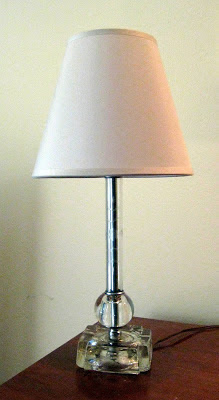 They are petite, with delicate etchings of vines and flowers on the base and stem.


When Mother passed away in July, the lamps came home with me to Florida. They sit on a three-piece Art Deco set that includes a drop-top desk from a Royal Scandinavian furniture maker. Amazingly, I acquired all three pieces at an auction for $75, and they are the pride of my furnishings.
The old-fashioned glass lamps are a perfect accessory.
While in Schenectady, I saw a large maribou-covered lampshade in the window of a vintage upcycling store. It was $200 which is about $188 more than I'm prepared to spend for a lampshade.
Today, I at last had enough confidence to tackle the job of recreating the look. Maribou is so right for the era, too. It evokes memories of those flapper gals with their feathers and beads.

It took more feathers than I thought -- about 11 feet. Each boa is two yards. I figure 7-9 feet, but I used all but a foot of two boas; each is six feet.
estimated 5 to 9 feet for the job.
I've go to go back to JoAnns fabrics and buy another boa tomorrow.
Next try, I will see if I can pull the feather rope a bit tighter and perhaps better defining the rows of the wrap.
It took only a few drops of hot glue to anchor the wrap here and there. The bottom row took the most, perhaps six to eight, so that it would be stay in place. As I wound upward, I used about three or four glue drops for each level.
Total cost of the DIY lampshade is $15.
A pair of these glass candlestick lamps were on my mother's vanity my whole life. They used to be my grandmother's, and they look 1920s.


When Mother passed away in July, the lamps came home with me to Florida. They sit on a three-piece Art Deco set that includes a drop-top desk from a Royal Scandinavian furniture maker. Amazingly, I acquired all three pieces at an auction for $75, and they are the pride of my furnishings.
The old-fashioned glass lamps are a perfect accessory.
While in Schenectady, I saw a large maribou-covered lampshade in the window of a vintage upcycling store. It was $200 which is about $188 more than I'm prepared to spend for a lampshade.
Today, I at last had enough confidence to tackle the job of recreating the look. Maribou is so right for the era, too. It evokes memories of those flapper gals with their feathers and beads.

It took more feathers than I thought -- about 11 feet. Each boa is two yards. I figure 7-9 feet, but I used all but a foot of two boas; each is six feet.
estimated 5 to 9 feet for the job.
I've go to go back to JoAnns fabrics and buy another boa tomorrow.
Next try, I will see if I can pull the feather rope a bit tighter and perhaps better defining the rows of the wrap.
It took only a few drops of hot glue to anchor the wrap here and there. The bottom row took the most, perhaps six to eight, so that it would be stay in place. As I wound upward, I used about three or four glue drops for each level.
Total cost of the DIY lampshade is $15.
Wednesday, October 24, 2012
The Florida to Cancun 14-Week Delayed Passport Blues
When I applied for my passport in July, I hadn’t even settled on a trip to take. I did not pay for expedited processes, because I knew I’d be traveling on Christmas break.
I had a passport back in the Seventies. Eventually, the papers got all stiff and a little moldy, and I tossed it out.
Bad idea. But that was the good old pre-911 days when Americans didn’t have to stand on one leg and spit nickels to prove you are a gen-u-wine, bone-a-fi-dee U.S. cit-eye-sin.
Submitting your old passport apparently earns bonus points and helps you win the amazing race not to lose the money one has paid for the trip.
Yes, I do have trip insurance but I didn’t notice “didn’t get my passport on time” as a reason for reimbursement.
Within three weeks, the State Department sent a letter saying my birth certificate was no good.
It was issued by Schenectady County with a seal, damned upstart Dutch province established long before the colonies became a united-states of anything – and who can trust those demmed furriners to know whether I was born or not.
I had to order a copy from the New York State Department of Health.
The next part of the cock-up is my fault – I did not read the fine print. I sent a check for $30 for 10-12 week processing, instead of $45 for two to four week processing. So sue me, my eyes are not as good as they used to be, I’m bad at paperwork, and I did this right after the death of my mom when I was seriously grieving and handling all the details of her passing.
When I called about three weeks later, I was told not to expect the birth certificate for a long time. So long that there seemed scant chance I could get it to the State Department in time.
New York State had a simple solution for that, however: Pay us $65 right now and we will get the passport to you in five to 10 days.
This turned out to be a lie, as it took 15 days. Nothing I could do about it and, of course, no refunds to me for their poor performance.
Being stressed out about the process, I next paid $56 for overnight delivery to the State Department and $72.72 (yes, really, 7-2-7-2, does someone have a number fetish in the Passport Office?) for expedited processing.
So, I guess I will be going to Cancun and the Mayan ruins for Winter Solstice and can slip through some crack in the cosmic egg or whatever is supposed to happen then.
I had a passport back in the Seventies. Eventually, the papers got all stiff and a little moldy, and I tossed it out.
Bad idea. But that was the good old pre-911 days when Americans didn’t have to stand on one leg and spit nickels to prove you are a gen-u-wine, bone-a-fi-dee U.S. cit-eye-sin.
Submitting your old passport apparently earns bonus points and helps you win the amazing race not to lose the money one has paid for the trip.
Yes, I do have trip insurance but I didn’t notice “didn’t get my passport on time” as a reason for reimbursement.
Within three weeks, the State Department sent a letter saying my birth certificate was no good.
It was issued by Schenectady County with a seal, damned upstart Dutch province established long before the colonies became a united-states of anything – and who can trust those demmed furriners to know whether I was born or not.
I had to order a copy from the New York State Department of Health.
The next part of the cock-up is my fault – I did not read the fine print. I sent a check for $30 for 10-12 week processing, instead of $45 for two to four week processing. So sue me, my eyes are not as good as they used to be, I’m bad at paperwork, and I did this right after the death of my mom when I was seriously grieving and handling all the details of her passing.
When I called about three weeks later, I was told not to expect the birth certificate for a long time. So long that there seemed scant chance I could get it to the State Department in time.
New York State had a simple solution for that, however: Pay us $65 right now and we will get the passport to you in five to 10 days.
This turned out to be a lie, as it took 15 days. Nothing I could do about it and, of course, no refunds to me for their poor performance.
Being stressed out about the process, I next paid $56 for overnight delivery to the State Department and $72.72 (yes, really, 7-2-7-2, does someone have a number fetish in the Passport Office?) for expedited processing.
So, I guess I will be going to Cancun and the Mayan ruins for Winter Solstice and can slip through some crack in the cosmic egg or whatever is supposed to happen then.
Sunday, October 21, 2012
Jupiter: Dappled Sunlight Through Canopy of Cypress Trees
The approach to Carlin Park in Jupiter, Florida, offers an outstanding canopy of cypress trees.

By this point in the drive, I had dawdled over where to eat so long that I created an impossible situation for myself.

In tourist towns and on the beach, one often pays for the view and quaintness, rather than the quality of the cuisine.
By this time, I wanted a hamburger, having consumed only two Dunkin' Donuts and an iced coffee all day. Well you know what they say -- America runs on Dunkin.
Since I've discovered how good the iced coffee is for half the price of Starbucks, I can't waste my money on the latter anymore.
I stopped in Delray Beach, another lovely small town voted in 2012 one of the most interesting small towns in the USA on Travel Channel.
It was crammed with couples from their 30s upward. Even so, I managed to find free parking.
By this time of a lovely busy Saturday evening, there were only two kinds of restaurants -- those that were crammed with couples and uncomfortable to eat in by myself or those that were empty and there suspected of bad food. Or else they'd be crowded, right?
I ended up grabbing some nachos at Moe's on Commercial Boulevard, bad food and not that cheap yet a satisfying end to a day in small-town South Florida.

By this point in the drive, I had dawdled over where to eat so long that I created an impossible situation for myself.

In tourist towns and on the beach, one often pays for the view and quaintness, rather than the quality of the cuisine.
By this time, I wanted a hamburger, having consumed only two Dunkin' Donuts and an iced coffee all day. Well you know what they say -- America runs on Dunkin.
Since I've discovered how good the iced coffee is for half the price of Starbucks, I can't waste my money on the latter anymore.
I stopped in Delray Beach, another lovely small town voted in 2012 one of the most interesting small towns in the USA on Travel Channel.
It was crammed with couples from their 30s upward. Even so, I managed to find free parking.
By this time of a lovely busy Saturday evening, there were only two kinds of restaurants -- those that were crammed with couples and uncomfortable to eat in by myself or those that were empty and there suspected of bad food. Or else they'd be crowded, right?
I ended up grabbing some nachos at Moe's on Commercial Boulevard, bad food and not that cheap yet a satisfying end to a day in small-town South Florida.
Stuart Offers Picturesque Water View and Small-Town Charm
I drove down Route 1 from Vero Beach to Stuart. There are many antiques and second-hand stores along the way.
Daylight was waning, so I didn't stop. Someday I will return and take my time.
I haven't stopped in Stuart since 2003. I've always enjoyed it's small-town charm and small parks on the water.

The lock and chain attests that crime is not completely unknown, however petty.

This mural with tile insets was one of the first things I observed after I parked. Parking is still free, by the way, not like here in downtown and beachside Fort Lauderdale.

Like so many other South Florida town, Stuart has taken care to maximize its old-time appeal.

This building advertises a Stuart claim to fame.

I'm not sure if I completely like it. Before, Stuart was just an old town; now it has uniformly lettered signs with an antique script and Caribbean-colored storefronts that look like a movie set.

Theater with live band music coming from behind the closed doors -- probably a practice session.

Garden entry to attorneys' office evokes memories of New Orleans.

Charming pink cottage advertises rooms available. I believe the back yard is on the water.

I wouldn't mind living in an apartment with a balcony overlooking the small-town doings.

If you look closely, you may see a dancing woman and a parrot on the trompe l'oeil balcony that decorates the facade of the plain exterior wall.
Fake window scenes between real shutter further the illusion.

Built along the river, Stuart has preserved several places where all residents can enjoy the view -- unlike the Palm Beach to Miami metroplex where tall condos and hotels dominate the sands.

Here some folks enjoy cool evening breezes, and it looked like a preacher or other speaker might have been preparing for a presentation.
A final look at Stuart -- this sailfish fountain shining brilliantly as it was backlit by a bright sunset.

Daylight was waning, so I didn't stop. Someday I will return and take my time.
I haven't stopped in Stuart since 2003. I've always enjoyed it's small-town charm and small parks on the water.

The lock and chain attests that crime is not completely unknown, however petty.

This mural with tile insets was one of the first things I observed after I parked. Parking is still free, by the way, not like here in downtown and beachside Fort Lauderdale.

Like so many other South Florida town, Stuart has taken care to maximize its old-time appeal.

This building advertises a Stuart claim to fame.

I'm not sure if I completely like it. Before, Stuart was just an old town; now it has uniformly lettered signs with an antique script and Caribbean-colored storefronts that look like a movie set.

Theater with live band music coming from behind the closed doors -- probably a practice session.

Garden entry to attorneys' office evokes memories of New Orleans.

Charming pink cottage advertises rooms available. I believe the back yard is on the water.

I wouldn't mind living in an apartment with a balcony overlooking the small-town doings.

If you look closely, you may see a dancing woman and a parrot on the trompe l'oeil balcony that decorates the facade of the plain exterior wall.
Fake window scenes between real shutter further the illusion.

Built along the river, Stuart has preserved several places where all residents can enjoy the view -- unlike the Palm Beach to Miami metroplex where tall condos and hotels dominate the sands.

Here some folks enjoy cool evening breezes, and it looked like a preacher or other speaker might have been preparing for a presentation.
A final look at Stuart -- this sailfish fountain shining brilliantly as it was backlit by a bright sunset.

Subscribe to:
Posts (Atom)